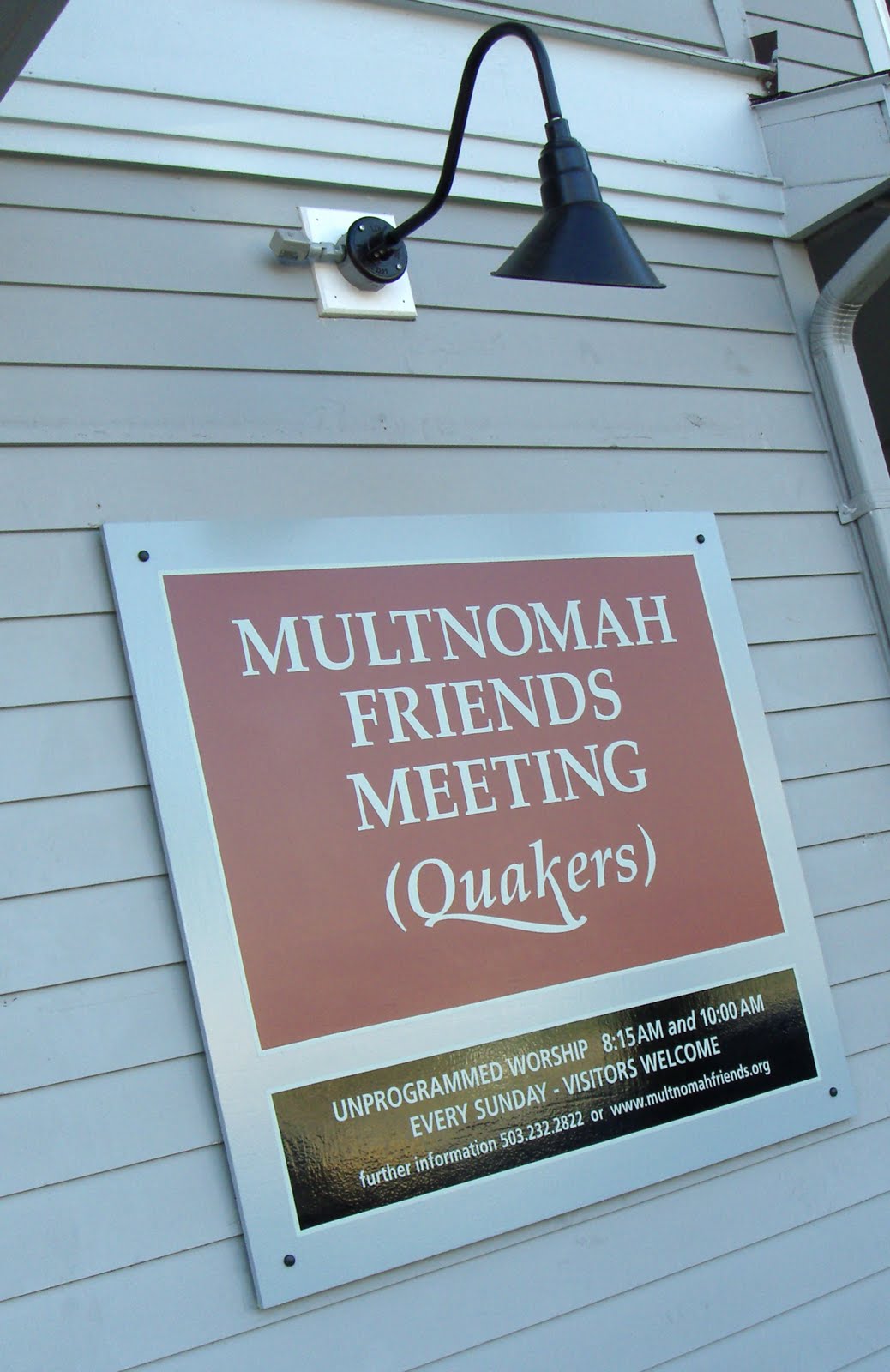
Thursday, October 13, 2016

From the Heart: The wellspring to action

Last Sunday in silent Quaker worship, I was obsessed by a “monkey mind” dominated by this absurdist presidential campaign.

Finally, I concluded, I simply had to let go. But how?

Then I realized the chaos was in my mind.

What if I moved all of that “stuff” to my heart?

It was surprisingly easy. I simply refocused on my heart.

I immediately felt peace move to my chest and then wash over me.

My mental churning vanished.

The hard turmoil in my mind had melted to a balm
in my heart.

The energy was still there, but I was different.

Everything had changed.

                  •  •  •

Could it be that we sometimes are “using” the wrong part of ourselves as we face life’s challenges?


Do some things require heart while others call on reason? Or is there a sequence of heart/mind or, more often, mind/heart that we should follow.

Quakers speak of “leadings.” Being led, almost compelled, to act. In the past, Friends have been led to women’s suffrage, the emancipation of slaves, civil rights, conscientious objection, prison reform. The list is long.

Thinking about those leadings, I see they have taken shape in both mind and heart, but ultimately heart spurs us to action.

The wellspring of leadings is in the heart.

Labels: , , , , , , , , , , , ,

Wednesday, May 25, 2016

Political discernment using Quaker testimonies

As a Quaker, I am helped in turbulent times by considering the five Quaker “testimonies.”

The testimonies are: Simplicity, Peace, Integrity, Community and Equality. (You can remember them with the mnemonic “SPICE”)

Recently I’ve weighed the three major presidential candidates against the testimonies and tried to assign grades to them. ABCDF.

I found it difficult because media reporting on the candidates often fails to provide necessary information to make a judgment on these topics.


Then again, much of the news coverage is relevant and helpful.

I also realized that I first needed to revisit the “SPICE”s for myself, particularly with regard to politics and public life.

It was a humbling experience. The “grade” I gave myself was, at best, a “gentleman’s C.”

Here are some of the questions I pondered.

Do I measure “simplicity” guided by my spirituality or do I surrender to cultural/political norms?

Am I at peace with myself? Am I at peace with paying taxes to support American military involvement (which includes atrocities)? Am I at peace with our system of "justice"?

Do I understand the word “integrity” in all its meanings, “strength” being one of them?

What community, or communities, am I part of? What are my responsibilities to them. What are my responsibilities to other communities beyond my own?

Do I truly believe we are equal? If so, how?

Now to the presidential candidates....


How do the testimonies apply to being president of the United States? It's easier to answer for some ("integrity" for instance) than others ("simplicity"?) Or are the testimonies simply important as measurements of personal character? Should we consider the "personal" and "presidential" as one? Are presidents forced to make decisions they would never want to make as individuals? Decisions about life and death, for instance. What does personal/presidential bifurcation say about "integrity"?

In an earlier draft of this little essay, I actually assigned “testimony” grades to the three leading candidates. Now I realize that my assessment is helpful only to me. It is filtered through my unique experiences, values and discernment.

What’s most important to you is yours.

So have at it. Take your time….

Donald Trump

Simplicity?
Peace?
Integrity?
Community?
Equality?

Hillary Clinton

Simplicity?
Peace?
Integrity?
Community?
Equality?

Bernie Sanders

Simplicity?
Peace?
Integrity?
Community?
Equality?

Labels: , , , , , , , , , ,

Wednesday, February 05, 2014

The Parable of the Turnbuckle


Last weekend I joined Santa Barbara Quakers in worship. Before settling into the silence, I gazed around the meeting room with its gracefully arching windows and two skylights. As my eyes swept across the ceiling, they rested on two parallel stay cables poking out of the ceiling. Each had been tightened by its own turnbuckle.

The modest fixtures were essential to holding the building together.

I stopped to ponder the turnbuckles to consider just how they did their job.

Because Quaker meetings often are trying to shore up this or that, I sought to apply to Friends the simple mechanics of the turnbuckle.

The key to the operation of a turnbuckle is that it is tightened by rotating a collar that is threaded on both ends to fit attached threaded screws, which are, in turn, hooked to the cables.

The telling point is this: the threads at one end go in the REVERSE direction as those on the other.

Without the reversal, the turnbuckle wouldn’t pull inward to tighten the cables. Of course the collar needs to be turned in the “right” direction. Turning it the other way loosens the cables.

Friends are notoriously, but thankfully, “threaded” in opposite directions (MANY opposite directions!). If we were all threaded the same way, neither tightening (nor loosening) would happen. We’d just unscrew ourselves, as it were.

So, like the turnbuckle, we are stronger for our “oppositional” threading, just as long as we learn to agree which way to twist our collars.

Sometimes learning requires loosening first before we discover which way to turn to make ourselves stronger, but in the end, together, we get it right.

All of which may sound familiar to those familiar with the old hymn "Simple Gifts"...


"...To turn, turn 'twill be our delight,
Till by turning, turning we come round right."

Labels: , , ,

Sunday, July 21, 2013

A Parable from the Duck Pond

My friend and fellow Quaker Josh von Kuster has written a parable directed toward Quakers, but it speaks to us all.

Once, ducks migrated all over, flying south every year in the winter, and north again in the summer. Their squawking as they flew  brought cool weather with them South and warm weather with them North. They went all over, looking for a peaceful pond where they could be free to stay year-round and the weather would be just right.  Finally, they found such a place., and settled. The migration stopped.

As the generations went by, the ducks taught each other of their forebearers’ travels. How they brought the weather with them when they squawked and flew.

One day, a little duckling didn't want just to learn about traveling and squawking. This curious duckling decided to live out its curiosity.

It wanted to actually travel and squawk.

The flock encouraged the duckling, such behavior being unfamiliar but exciting to them. So off it flew.

As the years went by, the flock kept teaching each other about the migrators. They found new and exciting ways to teach each other about their elders. They didn't notice the weather changing on their pond, they grew comfortable with the heat in the summer and the cold in the winter.

One day, the duckling was invited to come home. The duckling was missed by its friends so they asked the curious duckling to come and talk about migrating. Setting travels and squawking aside for a while, the curious duckling, now full-grown, came back to the pond. The curious duck told them of all it had seen, and how great the weather can be and how nasty. The duckling was brimming with knowledge and experience and wisdom and spoke of the wider world.

But the flock was not gathered only to hear the curious duck. It was so much fun talking about their elders and how things used to be far away in the past. It was even more fun coming up with new and exciting ways to teach each other about their proud traditions in the future. They were so busy talking about techniques and pedagogy they never took the time to ask the duckling what could be done to migrate again.

Labels: , , , , ,

Monday, January 09, 2012

The Guest in the Tree

Some of you may know that I hold the position of clerk of our Quaker meeting. It’s a two-year term, the job gets passed around, and in our egalitarian spiritual community, no one makes much of it.

But on occasion I’m reminded that, whether I like it or not, I’m the go-to guy.

Like last night when I got the phone call from Officer Gilbert of the Portland Police department.

“Mr. Seifert, I understand you are the person responsible for the Quaker meeting house here on Stark Street? Is that right?”

“Yes, I am the person responsible,” I conceded with a hint of hesitation and foreboding. “Tell me what this is about, officer,” I invited as visions of disaster bubbled up in my brain.

“Well, is the name Tre Arrow familiar to you?”

“Vaguely, isn’t he that environmental activist who camped up on a downtown building’s ledge for a few days several years ago?”

“That’s the one. Now he’s here in the fir tree in the backyard of your Quaker building. He’s yelling from up there. There’s a crowd here, some Occupy folks are shouting encouragement and the fire department has a ladder truck in place. We have the street blocked off.”

I could hear distant hollering in the background. A group chanted “Occupy the Tree! Occupy the tree!”

I heard myself say, “I’ll be right over, officer.”

It takes about 20 minutes to get from my house to the meetinghouse. That was enough time to gather my thoughts and run scenarios through my mind.

What if we have this guy in our tree for days? What if the crowd grows and “Occupies” our backyard? What if the chanting and yelling continue disturbing the neighbors in what the media would call a “normally quiet residential neighborhood.”


When I arrived I found pretty much what I imagined. It was a vision from the evening news. Flashing police lights. Squawk box commands. Barricades.

It was also an arcade for a media carnival complete with earnest correspondents and trucks equipped to broadcast “LIVE on the scene!” “Up-to-the-minute Action News.”

Before going to the backyard to assess the situation, I huddled with the police sergeant in charge. As we stood on the center line of the barricaded street, he calmly suggested that his officers and the fire department leave. There was really nothing they could do except attract unwanted attention. Wrestling Tre Arrow from his sylvan perch 60 feet above ground could lead to disaster.

I readily accepted the sergeant’s assessment and advice, and thanked him. The police and firefighters departed.

I was left to whatever might happen next, yet somehow a calmness descended on me.


As I went through the gate to our backyard, I had already decided to treat Tre not as a trespasser or intruder but as some kind of “guest.”

An uninvited guest, but a guest none-the-less. “Unexpected,” someone suggested later.

Precisely, an unexpected guest.


But who were these other folks standing around staring into the boughs above? I set about introducing myself, inquiring to whom we Quakers had the pleasure.

Peering up into the tree were the reporters with accompanying camera crews. Their lights sought out a shadowy figure who was heard far more clearly than he was seen. The silhouetted figure filled the evening with righteous ranting about the "rape of Mother Earth."

Also at the base of the tree was a small, surprisingly somber contingent from Occupy Portland.

I decided to invite the media to leave our backyard. As a journalist, I know that such requests are honored. Tre might be a “guest” but unwanted reporters and crews with cameras to be “played to” can be construed as trespassers. So the media quietly, and professionally, retreated.

As for the Occupy folks, I told them that our meeting had formally supported the Occupy movement and that I, in fact, was a member of Occupy's “Faith/Spirit” Spoke (or committee) They seemed duly impressed.

They were also impressed, and probably surprised, that I told them it was fine for them to stay. Perhaps they saw the absurdity of the “Occupy” movement's occupying part of itself.

And then there was a young woman who came up to me and quietly introduced herself as “Tre’s friend.” A friend concerned about Tre’s clearly agitated state. We quietly introduced ourselves and talked. She filled me in. She thought that once people left, her friend would come down. Indeed after the camera crews and reporters established a public safe haven on the distant sidewalk, Tre began to work his way down the tree to the ground.

I greeted him as he lowered himself from the fence at the base of the tree. I shared with him that Multnomah Friends Meeting considered him a guest.

“Thank you, thank you. You Quakers are so great,” he said as we shook hands.

I guess that was a bonding of sorts. Barefooted and a little worse for wear from his climb up and down the tree, he made his way to the media waiting at our gate. There, from our side of the fence, he proceeded to lecture the reporters on the state of the planet. It went on and on...such is the state of the planet.

Finally his quiet companion whispered in my ear, “You are going to have to stop him or he will just keep going.”

“How is he with people placing limits on him?” I asked

“Not so good.”

Great, I thought. “Let me see what I can do,” I whispered back.

When it was clear to everyone (perhaps even to Tre) that Tre’s lecture was looping back on itself, I put my hand on his shoulder and said, “I think it’s time to wind down.”

He seemed almost grateful for my interruption. He turned and we shook hands. “You’ve been very understanding,” he said. “Thank you.”

Then he led the media gaggle across the street where he resumed his sermon until, at last, everyone lost interest and wandered off into the cloudless winter night.

As more than one person noted, the moon was full.

I later joked with other Friends that there is nothing about dealing with tree protests in the clerk’s job description. But, I was reminded, there are references to being “open to the spirit” and “finding one’s center.” If not exactly a job description, the Quakerly words provided the guidance I needed Sunday night — that we all needed in this little tableau from our times.

For a news clip of what happened go HERE. Yes, that’s me in the baseball cap with our “guest.”

Labels: , , , , , ,

Thursday, October 27, 2011

Quaker support for the Occupy Movement

A couple of weeks ago our Quaker meeting approved a minute in support for “Occupy Portland.”

It reads:

We, Multnomah Meeting of the Religious Society of Friends (Quakers), support social and economic justice. We oppose subservience to powerful financial interests. We support Occupy Portland and other current non-violent protests seeking justice.

So the question is: What next? What, exactly, does it mean to support Occupy Portland?

I’m not being glib here. Occupy Portland folks seem to ask the same question every day. Meanwhile, there’s food to be ladled out, dishes to be washed, disagreements to be resolved, anxieties to be calmed and trash to be collected.

And that’s just a partial listing of "household" chores

In the domestic details of protest, the cause can be lost.

Is the “Occupy” movement beginning to look like a lost cause?

As long as that cause is “social and economic justice,” we, as a nation dedicated to it, can’t afford to lose.

The problem is that we need to know what is to be gained. Here’s where Quakers can help.

Those in the movement already are versed in and practicing the tried-and-true Quaker decision-making process that is built around consensus. What the activists don’t know are Quaker testimonies and values. They are why so many Quakers support this vibrant movement. The movement, in turn, has produced the energy to carry these values forward to the society at large.

So what are we talking about when we refer to the values of the Religious Society of Friends, commonly known as Quakers?

Here there are, couched in the context of “social and economic justice” circa 2011.

The starting point is that there is that of the Spirit in everyone. Some would substitute for “Spirit” the word “God,” “The Divine,” “the Light,” “the manifest” or “the beyond within.”

Frankly, the words don’t matter. If you are alive to an inner life and Light, you know what I’m talking about.

The Spirit is alive in the 99%, and, yes, in the 1% — however faintly. Its omnipresence is our hope.

The actual testimonies number five.

Simplicity. Simplify our lives. Know that the accumulation of objects impoverishes the soul and leads to injustice. Consider that less is indeed more — more for all.

Peace. Our souls are as impoverished by war and strife as much as they are by excess, materialism and greed. As we seek peace and justice, we must do so non-violently. Unless our movement is grounded in peace, it will destroy us — physically and spiritually.

Integrity. It is not enough to espouse what we believe; we must live it.

Community. We act for the greater good of community knowing that acting solely for ourselves is spiritually bankrupt.

Equality. We are equal and one in Spirit. We see and feel ourselves present in each other. We don't just treat each others as equals. We are equals.

Conveniently, the testimonies form the acronym S-P-I-C-E. If you add divine spiritual love to it, you get “SPLICE.” Together they are what Quakers, in support for the protest, bring to the this liberating, dynamic movement for social and economic justice.

Labels: , , ,

Friday, September 23, 2011

A Quaker Sunday in a 'Year of Sundays'

Amanda Westmont and Joel Gunz are local, self-avowed secular, religious reporters who write an entertaining, irreverent blog titled “Year of Sundays.”

Their catchy motto is “We go to church so you don’t have to.”

And so they have gone — to a wide variety of congregations.

Eventually, the time would come for the couple and their children to visit our Quaker Meetinghouse on Stark Street. I’ve been looking forward to meeting them and learning what they might have to say about Multnomah Friends.

On August 7, they arrived at our door.

By chance, I welcomed them after they introduced themselves as the authors of "Year of Sundays.” A couple of us complimented them on their blog and its wry perspective.

I hoped they would find Quakers as intriguing and challenging as I do, even after nearly 50 years of attending “unprogrammed meetings.”

In lay terms, “unprogrammed” means we worship largely in silence and have no pastor or minister. There is not a “programmed” order of service. Much more can be found about unprogrammed Quakers HERE.

So what would these two affable, skeptical, secularists have to say about us after their visit? In mid-September, we found out.

Joel’s name appears on the post but my guess is that his impressions reflect Amanda’s as well.

I anticipated a review that might actually reflect the vitality of our meeting. For a congregation that avoids any kind of proselytizing, we are seeing astonishing growth, particularly among young people. The obvious journalistic question is “Why?”

But to ask the question, you’d have to be familiar with the history of the meeting, or at least ask, “What’s with your congregation these days?”

But Joel never asked.

In journalistic parlance, he “missed the story.”

In fairness to him and Amanda, it was understandable. Their purpose was to report on THEIR experience during a two-hour visit. The first hour was for silent worship (punctuated by spoken ministry); the second hour was for socializing.

What they detected, and reported on, was an unquestioning, even stifling, uniformity of liberal political correctness.

End of story.

I’ve seen this happen before. People seem to want to dismiss Quakers by putting them in some familiar bag. Unfortunately, we provide them with outward signs that help their cause.

I think the stereotyping also comes from the fact that, inwardly, we are scary. Quakers call on those who worship with us in silence to look within themselves. Oh-oh. You actually have to plumb unplumbed depths. You can either do it, or at least try to do it, or you can run from it.

That’s what Joel, using his glib prose, did. We Quakers simply became grist for the “Year of Sundays” mill.

What did I expect? What did I learn from Joel and Amanda’s visit?

I expected that they would see how unique we are. That we are “radically inclusive” — we are devout Christians, devout atheists and, yes, devout skeptical, pen-wielding secularists.

Rather than being unquestioning, as Joel portrayed us, our spiritual seeking is manifestly driven by questions. We call them “queries.” Each month we post one on two walls of the large, sky-lit room where we worship. Did Joel and Amanda notice? Examples: “How do we exercise our respect for the balance of nature?” and “Do we center our lives in the awareness of the presence of God so that all things take their rightful place?” and “Do we keep to a single standard of truth so that we are free from the use of judicial and other oaths?”

Three centuries ago in England, Quakers were considered a “Dangerous People.” Many Friends share the belief that, in today’s wayward society, we still must be a “Dangerous People” — “dangerous” to injustice, inequality, deceit, consumerism and the destruction of the planet.

At the very least, to folks like Joel and Amanda, we should seem, if not “dangerous,” curiously, strikingly challenging.

Apparently not.

If Joel is right and we are simply predictably liberal and politically correct, we have failed to be true to our tradition and our callings.

Clearly in the case of Joel and Amanda, we failed to convey who we are and what it means to be a Quaker.

We have work to do.

Labels: , , , , ,

Tuesday, August 23, 2011

Considering "Joys and Concerns"

We Quakers traditionally seek to learn about each other and to share through expressions of “Joys and Concerns.”

I find myself increasingly relying on these two terms as I go about life. At the very least, they provide balance and open communication.

But I also have come to question whether they provide the proper “frame” for our feelings and experiences. How much outside, and even inside, the Quaker frame of “Joys and Concerns” are we missing?

Consider the defined margins of “joy” on one extreme and “concerns” on the other. Beyond those margins are certainly other feelings. Beyond “joy” consider “ecstasy” and “bliss.” A vast emotional space reaches beyond “concerns,” a word that seems steeped in traditional British understatement. Consider, for instance, “stress,” “worries,” “anxieties,” and even “paranoia.”

Don’t get me wrong. I’m not suggesting that Quakers replace our “joys and concerns” with “bliss and paranoia” (or some such). But what I am suggesting is that the words we choose may limit our awareness and discernment of Truth.

And what about all that falls within the Joy-Concern frame? Why do we share only joys and concerns? How about, for example, sharing “interest” or “passion” or “anger” or “love“ or “disinterest” or “ambivalence”?

Some feelings have little or nothing to do with joy or concern.

Consider too that joy and concern are closely related. In fact each is essential to defining the other. A world without concerns by necessity would be one without the joy of putting concerns aside. A world without joy would be a flat, depressing landscape where concerns wouldn’t be recognizable.

So why must “joys and concerns” be kept distinct? Can we find ourselves in situations that produce both simultaneously?

If you are like me, you may even find joy in a concern. Concern can lead, for instance, to an opening that brings with it the joy of creativity, accomplishment and giving. In Quaker terms, a concern is the beginning of a “leading.”

You may also find concern in joy. Recently I’ve found myself expressing joy at holding a position of responsibility that brings satisfaction. In the same breath my joy evokes the question, “Am I missing something? Has my joy blinded me? Do people I work with have concerns I’m unaware of?”

It would actually make me feel better to know of concerns. Learning them brings me the joy of awareness and the opportunity to help.

Labels: , ,

Friday, July 22, 2011

How the Internet shapes decisions — a Quaker's perspective

Communicating via e-mail, texting and Facebook exchanges present a host of inherent problems. Unless you are a Writer (that’s with a capital “W”), such communication is often one-dimensional, lacking inflection, dramatic pauses, and texture.

If you agree those limitations pose problems, consider the loss Quakers experience as they try conducting business on the internet.

Traditionally Quakers rely heavily on silent "gathered" reflection to discern what to do. Yet silence “plays” about as well on the internet as it does on talk radio. Imagine Rush Limbaugh interrupting a debate (usually one-sided) with “Let’s pause a moment in silence to consider what the caller is saying.”

Quaker silence gets even more complicated because Friends seek to be “spirit-led” in the stillness of reflection and meditation. When was the last time you sought the spirit as you were e-mailing or texting? I’m not saying it doesn’t happen (it is more likely in the pauses of text exchanges than in, say, board room discussions or political debates), but it’s increasingly unlikely in this rapid-fire world.

For many Quakers, “spirit-led” means led by God. As a Friend recently commented, “When I look into the eyes of another, I am looking into the eyes of God.” The comment comes from the core Quaker belief that there is “that of God (or the Spirit, or both) in everyone.”

But if you aren’t looking at another person, you are unlikely to fully feel in the presence of their divinity. And if they are not looking into your eyes, your own divine presence may be forgotten. Our communication is shaped by that presence, or, alas, lack of it.

I raise these questions because of the tendency to conduct more and more business through the internet, conference calls, and, yes, video conferencing. I’m suggesting, as many others have, that every medium shapes its content — and hence the outcome of communication.

We all should ask ourselves how our decisions are altered by the medium we choose. And then we should consider what we might have decided had we met face-to-face — sharing in timely silence, allowing the “spirit” to lead us, seeing the divine presence in each other’s eyes.

Question: How might the decisions of our democratic institutions (Congress, the judicial system, elections) be different if they adopted these practices?

Labels: , , , , , , ,

Friday, June 17, 2011

Do "God" and "Spirit" equate?

Our brand of Quakers, liberal and “radically inclusive,” gives itself a lot of leeway when it comes to what many folks, including most Quakers, call “God.” Because some of us are uneasy with the word “God” and its associations, we variously substitute “the divine,” the “Light,” “the indwelling spirit,” or simply “the Spirit.” A smattering are Quaker agnostics or atheists.

I personally have trouble with “God” for oft-cited reasons. Most come from ingrained Biblical references to judgements, damnation, patriarchal superiority, cloud dwelling, gray beards and retribution.

To me, they make “God” hard to love. So I'm a "Spirit" person.

When I’ve talked with fellow Quakers about our varying terminology for something which is ultimately ineffable, I get assorted reactions. To be sure some welcome the discussion, but others signal discomfort with visual signals (a raised eye-brow, a hardening around the mouth, a blank stare). In effect, they are saying, “Don’t go there,” or “It’s irrelevant,” “Been there, done that” or “How much time do you have?”

One, long-time Friend abruptly dismissed the substituting of “Spirit” for “God.” “It isn’t the same thing,” she insisted. That comment has stayed with me and begs to be put to the test.

So here’s the test, or at least a test. I’ve taken several familiar references to “God” and substituted “Spirit” for them. I’ll leave it to you to decide whether “God” and the “Spirit” equate. Are we talking about the same thing? Can you read beyond the words to the meaning? Or do words fail us — literally?


“A mighty fortress is our God.”

A mighty fortress is our Spirit.


“God, the father.”

Spirit, the father.


“God — our rock and our salvation.”

Spirit — our rock and our salvation.


“Fear God and his Commandments.”

Fear the Spirit and its Commandments.


“The Kingdom of God is within you.”

The Kingdom of The Spirit is within you.


“With God, all things are possible.”

With the Spirit, all things are possible.


"In God we trust"

In the Spirit we trust.


“Our Father who art in heaven...”

Our Spirit which art in heaven...


“Blessed are the pure in heart, for they shall see God.”

Blessed are the pure in heart, for they shall see the Spirit.


“Blessed are the peacemakers, for they shall be called the sons of God.”

Blessed are the peacemakers, for they shall be called the sons of the Spirit.


I’m tempted to launch into an analysis of what this little exercise reveals, but for now I’m more interested in where it takes you. For one thing, you might want to add your own quotations to the list of “God” references to see whether they meet the “spiritual” test.

Next, I’ll post some “Spirit” quotations and substitute “God” for “Spirit” to see where that takes us. (I have now posted it HERE)

Stay tuned.

Labels: , , , ,

Thursday, May 26, 2011

A message for Quaker non-Quakers

I have many friends whom I consider to be Quaker non-Quakers. By that I mean they hold the values of Quakers without knowing it.

There’s part of me that would like to whisper, “Pssst. You are a Quaker non-Quaker.”

There’s another part that tells me to let it be.

First what are the values we share? Quakers call them “testimonies” and they are usually listed as Simplicity, Peace, Integrity, Community and Equality. They happen to create the acronym “SPICE." Some add Stewardship or Sustainability to the list. Make that “SPICES.”

In these times, each deserves long, deep contemplation and consideration. We need to consider whether we, Quakers and non-Quakers, truly live by these testimonies.

But for me, as a Quaker, there’s more. Quakers add a spiritual dimension to the testimonies. We believe we are “spirit-led” to these values and that the spirit will lead us to incorporate them into our lives.

So while I share the Quaker testimonies with many non-Quaker friends, I also want to explore the spiritual dimension with them as well.

Our secular culture does not invite such exploration. To push into matters of the spirit smacks of unseemly proselytizing. I hear the voice again, “Let it be” (The voice, by the way, sounds suspiciously like John Lennon’s.)

Quaker author Robert Lawrence Smith “speaks my mind” (as Quakers say) when he writes in the introduction to his illuminating and highly accessible book, “A Quaker Book of Wisdom”:

"It is my ever-growing conviction that the compassionate Quaker message badly needs to be heard in today’s complex, materialistic, often unjust, and discriminatory society. Every day brings new public debate over issues Quaker have always addressed: war and peace, social justice, education, health care, poverty, business ethics, public service, the use of world resources. The list goes on....”

Later he says, gently touching on the timeless leadings of the spirit, “To me, Quaker values of simplicity and silent contemplation, truth and conscience, seem more important now than ever before....the basic humanistic Quaker precepts of valuing racial and gender equality, promoting social justice and nonviolence — and, yes sometimes civil disobedience —seem to me to me so modern, so relevant to today’s society, that when I thought about writing this book I was suddenly surprised that no one had written one like it. What particularly struck me is that the Quaker ideals formulated in the Seventeenth Century remain contemporary in every sense, and the basic injunction to ‘let your life speak,’ to live each day in accordance with these beliefs, seems totally untarnished by the passage of time.”

That is exactly the message I want to share with you, Quaker non-Quakers.

For more, much more, on Quakers, go to www.quaker.org.

Labels: , , , , , , , ,

Monday, April 04, 2011

An Ocean of Ink

Quakers made the front page of the New York Times last Friday.

Was the story about the Religious Society of Friends' on-going struggle for peace?

Was it about the effectiveness of the Quaker lobbying group, the Friends Committee on National Legislation?

Was it about the fact that there are far more Quakers in East Africa than there are Quakers elsewhere?

Was it about the "timeliness" of the Quaker testimonies: Simplicity, Peace, Integrity, Community and Equality and how they speak to today's world?

It was not.

The story was about a "tense" division between the Friends Seminary (in essence a Quaker preparatory school), tucked away in lower Manhattan, and the New York Quarterly Meeting, a Quaker religious governing body.

Excuse me if my eyes glaze over. The story may have been of interest to a relative handful of Times' readers. Quakers no doubt read it with raised brows.

As a journalist and as a Friend, I was saddened because I realized that the Times editors had just blown their quota of front-page Quaker stories for a decade. Quakers deserve better (see above).

On Sunday I was still grumbling about the story and the Times' definition of front-page news. In the course of being with Friends at our meeting house, I had occasion to consider Quaker founder George Fox's revelatory vision of an "Ocean of Light." In his journals, he describes his epiphany this way:

I saw the infinite love of God. I saw also that there was an ocean of darkness and death; but an infinite ocean of light and love, which flowed over the ocean of darkness.

I've always related the Ocean of Light to Quakers' silent worship. Our worship room happens to be graced with a large, central skylight. The light well draws the sun's warmth and light into our worship. Light and silence; silence and light.

I have more trouble with the image of an "ocean of darkness and death." Death is as real as life. And darkness defines light. Indeed I have found as I have grown older that the prospect of death increasingly defines and enriches what I do with life. Could death recast "life"?

So what is this "ocean of darkness"?

Suddenly, with the Times story on my mind, it came to me. INK! It is a pitch-black sea of ink.

An ocean of stories about petty (or not-so-petty) conflicts written with barrels of ink. It is the ink that each morning greets me with the terrible news of the world and puts me in a sour mood until I push aside these black dispatches. It is the ink that obsesses over the foibles and tragedies of humanity. It is ink that so often blots out and ignores the light of love.

I confess that I smiled as this strange, inky thought came over me. I knew I would likely write about it, using the Internet's equivalent of ink. These very words you are reading may not be an "Ocean of Darkness," but they do constitute a puddle of black even as, I pray, they may reflect some light.

And so, dear reader, contemplate the "Ocean of Light" in the purity of silence....

Labels: , , , ,

Wednesday, February 23, 2011

As others see us: Quakers as "suicide cult"

I’ve recently been wondering how Quakers (I happen to be one) are perceived by the vast majority who aren’t.

Today, while reading the New York Times, I got an unusual and troubling glimpse from reading a story about a Navy midshipman, Ensign Michael Izbicki, who has just emerged successfully from the surreal experience of explaining why he is a conscientious objector.

After a two-year legal struggle, he has finally been discharged from the Navy.

It’s a bizarre, ironic story, reminiscent of “Catch-22” in many ways.

What especially caught my attention, given my interest in how Quakers are perceived, was this paragraph about Izbicki's inquisition at the hands of the Navy:

“One Navy commander suggested that the pacifist strain of Christianity that Mr. Izbicki embraced was inconsistent with mainstream Christian faith. The same commander likened the Quakers, who supported Mr. Izbicki, to the Rev. Jim Jones and his People’s Temple, a suicide cult.”

Alas, the commander is not named in the story. We need to talk. Nor does the story expand on the commander’s Jonestown/Quaker comparison, but allow me to speculate.

First, a little history is in order. The infamous Jonestown mass suicide of 1978 in northern Guyana resulted in the deaths of more than 900 Jones followers, who drank poisoned Kool-Aid and died. It was the largest mass suicide in the history of this country.

My speculation about the commander’s thinking goes like this: Because Quakers follow a testimony promoting peace and refraining from and opposing participation in war, they are, in effect, committing suicide at the hands of this nation’s murderous enemies.

That, in itself is a contradiction. Suicide, by definition, is death at one’s own hands. When one knowingly chooses to die at the hands of someone else, that is commonly referred to as martyrdom. The pages of history are full of those who put their lives on the line to die for a greater good. One died on a cross 2,000 years ago. But that, commander, is another story.

The U.S. military would have us believe that its members are martyrs to such a good. It’s a tough sell, and Ensign Izbicki wasn’t buying it, especially when he was told that, from a submarine armed with nuclear missiles, he might be called upon to kill innocent civilians.

In my view, joining the armed forces is more akin to suicide. First, one increases the chances of being killed for politically ginned-up causes. If you don't believe me, dip into "War is a Lie" by David Swanson who lays out the lies our nation's leaders have told to justify going to war.

Moreover, on-duty military personnel are literally killing themselves (ie. committing suicide) in shocking numbers. In 2009, the suicide rate in the military was higher than the civilian average. Fifty-two Marines and 48 Sailors committed suicide in 2009, according to official reports. As of November of that year, 147 soldiers had taken their lives. Air Force officials reported 41 active-duty suicides in 2009.

Then there is the rate of suicides among veterans. Veterans Administration records show there are an average of 950 suicide attempts each month by veterans receiving some type of treatment from the Veterans Affairs Department. (Statistics aren't available for veterans not being treated.)

As ensign, Michael Izbicki was already agonizing over the possibility that he might be called on to mash a button that would lead to the obliteration of civilian populations. If he were ever forced to live with performing such a deed, it is entirely conceivable his “service to our country” might drive him to suicide too.

As I say, commander, we need to talk. Might I suggest, sir, that you and your colleagues might just be commanding your own Jonestown. Call it a "military cult."

But don’t believe me. I’m not a “mainstream Christian.” I’m just a member of a Quaker “cult.”

Labels: , , , , , , , , ,

Thursday, February 10, 2011

My Quaker elevator talk

Quakers realize that most people don’t have a clue about Quakers. What they know often begins and ends with the guy in the funny hat on the oat meal carton.

Some of us in our Quaker meeting have been working on how to describe ourselves — briefly. Our model is the 30-second elevator speech.

It’s hard to imagine the subject of Quakers coming up on an elevator, but suppose....

“Quaker?” says the stranger. “Aren’t you kind of, like, Amish? The oat meal guy. Virtuous and old-fashioned. Kind of odd? Quaking even?”

“Do you have 30 seconds?”

“All the way to the 30th floor.”

I take a breath.

“Start with ‘spirit.’ There's something in each of us that is spirit. Many of us call it ‘God.’ Many of us don’t call it ‘God.'

"That's okay. We should be free to call it what we want.

"Friends— that’s what we call ourselves — Friends know we are different when it comes to words and theology. We are happily and variously Christians, atheists, Buddhists, Jews.... We think of ourselves as 'radically inclusive.' We know we all experience this ineffable living force — call it what you will.

“Quakers find that worshiping in silence — being beyond words — centers and deepens our relationship to this "it," this inner spirit or God. Stillness also deepens our relationship with each other. Sometimes, a Friend is led to speak out of the silence, to share ‘ministry.’”

“Through silent worship and words that emerge from it, we have been led to five guiding truths. We call them ‘testimonies.’ They are...

“Simplicity. Just as our worship is simple, the spirit leads us to live simply.

“Peace. Because spirit or God is in everyone (EVERYONE regardless of belief or non-belief), we strive to live in peace with all.

“Integrity. The spirit leads us to adhere to the truth as we discern it.

“Community. We are united and one in love, worship and the manifest spirit of many names.

“Equality. All are equally in and of the spirit.”

“That’s it. Oh, the testimonies are easy to remember; they spell the acronym ‘SPICE.’”

The elevator chimes. Its door slides open onto the 30th floor.

"I just wish we had another 30 floors for silence," I say.

The stranger touches my shoulder on the way out.

“Spirit or God, silence and SPICE,” he says with a spreading grin. “Elevating!”

As the door shuts, I'm left with a small problem. As is, the speech clocks in at over 45 seconds. Should I hold the elevator door open for 15 seconds for the sake of “integrity,” “community,” and “equality”?

And what about those extra floors for silence? Maybe that's why we have skyscrapers.

For more than an elevator ride's worth about Quakers, go to www.quaker.org

Labels: ,

Wednesday, June 23, 2010

Beside the still waters . . .


Quakers describe their worship as “silent.”

Nearly all of our worship is in silence. The silence is broken only when someone is compelled to “share ministry” from the spiritual depths of silence.

But the word “silence” fails to adequately describe our worship.

I prefer to think of it as stillness.

Silence is, as they say, “necessary but not sufficient” for stillness.

Indeed all kinds of “noise” inhabits silence. Physical restlessness, distractions, worries, the mundane (Did I feed the cat? Did I water the plants?).

Stillness is altogether different.

That difference swept over me in the course of worship last Sunday.

My worshipful stillness led me to the image of a still pond. No ripple disturbed its surface.

My fellow worshippers and I sat in a circle around tranquility.

I’ve seen ponds and lakes like this. In their glassy stillness, I’ve seen clearly and deeply beneath the surface. Down to the very bottom. Seen through the deep, cold currents, to the stoney bed that quivers in animated distortions of light and shadow. To reeds that sway in gentle waters.

That’s where I went in the stillness of Sunday’s worship.

Later I thought of the 23rd Psalm. “He leadeth me beside the still waters.”

At their core, Quakers believe God (or, I prefer, the “Spirit”) is in everyone. In the stillness of worship, we embrace it and let it lead us.

It was that spirit that led me beside these still waters. It was that spirit that was stilling the waters and allowing me to see into them.

There was more.

Sometimes in meeting we all have stilled the waters. We simultaneously experience the depth and clarity. We call this experience “a gathered meeting.”

I did not want to speak out of the silence of any of this to my fellow worshippers. I could feel they were, in their own ways, already at one in the stillness.

The last thing I wanted to do was to send blinding ripples — words — across the surface of our pond.

I sought only to protect the stillness, for our worship had immersed us in the sacred.

Labels: , , , ,

Thursday, January 28, 2010

On calling ourselves "friends"

Governments, political groups and corporations are notorious for twisting the meaning of words. “The Defense Department,” "The Justice Department," “The Central Intelligence Agency,” “Pro-Choice,” “Pro-Life,” “Death taxes,” “Outsourcing,” “Downsizing,” etc.

In “1984,” George Orwell created an entire society reshaped by twisted meanings.

And, of course, technology is constantly changing meaning. We don’t really “watch” television. Most often we gaze uncritically at it. With audience surveys, television is really "watching" us.

We don’t talk “on” the phone; we talk through it.

Thanks to Facebook, one of the most blatant twists in meaning in recent years has been to the word “friend.”

Clearly not all our Facebook “friends” are friends. Most are, at best, acquaintances or connections. Many are institutional, consumer connections.

We know this, but strangely, we have gone along with this bizarre misappropriation of the word "friend." What choice do we have? We are increasingly living in a machine-defined world.

I don’t want to come down too hard on Facebook’s use of the word “friends” because I happen to belong to a group called “The Religious Society of Friends.” We are more commonly known as “Quakers.”

I fear that, in our own way, we Quakers have also done a grave disservice to the word “friend.”

The origin of the use of “Friends” to describe Quakers comes from the New Testament. The reference is from John 15:15 where Jesus tells his disciples “Henceforth I call you not servants; for the servant knoweth not what his lord doeth: but I have called you friends….”

Note that Jesus did not say “Friends” with a capital, as it is written in “Religious Society of Friends.” He said lower-case “friends.” It’s fair to assume he meant it exactly that way. It wasn’t just a manner of speaking. He considered the disciples to be his friends, and he wanted them to see him in the same way.

“friends,” with all that means. Think about what it means to be a friend.

The problem is that whenever I speak to my fellow Quakers as a group, I address them as “Friends,” with a capital. Many Quakers do this. “Friends, let’s consider the best way to proceed etc.” Or we might refer to a fellow Quaker as a “Friend.” Sometimes we say that we should act “in the manner of Friends.”

It would often help more if we simply acted in the manner of, lower case, friends.

Somewhere along the way what Jesus meant by “friend” became an institutional relationship defined by “Friend.” The word was drained of its meaning.

Recently I’ve shared my concern about this change with my fellow Quakers. I've urged Friends to become reacquainted as friends. “Friends” should be friends. Indeed early Quakers in the mid-Seventeenth Century intended exactly what Jesus did when they chose the name from the Scriptures.

To preserve their intention — to preserve true friendship — those early Quakers would have done well to have written the fledgling group’s name as “The religious society of friends.”

But organizations, like technology, change the meaning of words. They twist meaning. It’s up to us to retain it to safeguard meaning in our lives.

Labels: , , , , ,

Sunday, November 25, 2007

Justice — a missing Quaker testimony?

My ruminations in the silence of this morning’s Quaker meeting left me with unfinished business.

I’ve long agreed with those who assert that peace and justice are inextricably linked. You can’t have one without the other.

Peace, or course, is among the five Quaker testimonies, but I have been perplexed that justice — so essential to peace — is not among the other four.

So the question that filled my silent meditation was this: What does justice have in common with the other testimonies — simplicity, community, equality and integrity? Are the four adequate to satisfy peace’s requirement for justice?

I decided to search for an answer by pairing each testimony with justice.

Justice — Simplicity
Of the four testimonies, simplicity bears the least obvious connection. I suppose the simpler our desires are, the easier it is to arrive at justice. My guess is that the simpler our lives, the less likely questions of justice even arise.

Justice — Community
This one is like peace. Injustice is antithetical to community. Successful communities are, by definition, just.

Justice — Equality
Written into law is the idea that we are equal under it. We will be judged equally. To the extent we aren’t, there is injustice. Beyond strict legal considerations, we believe in social justice and social equality, which are closely related. No community can be at peace — can in fact be a true community — without social justice and social equality. By social justice and social equality, I DO mean economic justice, but I DO NOT mean economic equality. Economic justice means economic needs are met. In a world of limited resources, economic needs are dictated by the global requirement for simplicity. The maxim “live simply so that others may simply live” is a statement about justice.

Justice — Integrity
Of the five testimonies, I find “integrity” to be the most illusive. In its most basic it means being trust-worthy and fair. Certainly justice must be that. If we can’t trust our system of justice to be fair, if it lacks integrity, all the other values mentioned disintegrate.

Finally, it helps to look at peace’s relationship to justice. As noted, without justice, there can be no peace; without peace, there can be no justice. War is inherently unjust.

Beyond that, the administration of justice should create peace. Establishing and preserving a lasting peace should be built into any just resolution. Likewise, anyone committed to peace and its maintenance, must establish an accepted, durable conception of justice, one that incorporates equality, simplicity, integrity and community.

Labels: , ,